25+
Years researching wellbeing and resilience


Background
Dr Justine Gatt started as a neuroscientist asking careful questions — about the brain, genetics, and why some people still thrive despite trauma and adversity.
Over twenty five years, those questions grew into full research programs: twin and brain-imaging studies of flourishing, a longitudinal study following resilience after childhood trauma across more than a decade, and clinical trials testing wellbeing interventions in children, adolescents, and adults.
That body of work includes COMPAS-W, a six-domain wellbeing framework she developed and published through peer-reviewed research — now used internationally across resilience, ageing, and population mental health studies. She continues to lead active research programs, and holds academic and research leadership appointments as a Professor of Psychology.
As the founder of Tilt Your Life, she has created a neuroscience-informed platform that translates the best of published wellbeing science into practical tools for everyday life.
Tilt is the applied expression of that work: rigorous science, made usable, and human. It is what happens when that research is asked a different question: not what do we know, but what can someone actually use.
25+
Years researching wellbeing and resilience
110+
Peer-reviewed publications
100+
Invited talks worldwide
15+
National and international awards and prizes
I have spent more than twenty years studying why some people flourish even through difficulty. Tilt is my attempt to make what I've learned actually useful.

Dr Justine Gatt
Neuroscientist · Founder

A definition
Justine's guiding principle, across every part of her research, is prevention before reaction — the belief that wellbeing is a foundation to protect early, not a reward for surviving difficulty. Working at scale only matters if the science is sound and the application is careful, which is part of why she moved beyond the bench: the evidence was needed in the places people already live their lives, not only in policy rooms and journals.
Tilt was built on that same principle, at an individual scale. Not a clinical tool. Not a self-help shortcut.
A rigorous, carefully built platform that meets people where they are and helps them move, gently, in a better direction.
Tilt is grounded in published wellbeing science drawing on peer-reviewed research across neuroscience, psychology, resilience, and behavioural science.
Tilt is grounded in published wellbeing sciencedrawing on peer-reviewed researchacross neuroscience, psychology,resilience, and behavioural science.
Dr Justine Gatt has not only drawn on that field but contributed to it, and Tilt reflects both the breadth of that evidence base and the depth of her expertise within it.
COMPAS-W was developed by Dr Justine Gatt as part of her broader program of work on wellbeing and resilience. It is a validated six-domain framework that looks at wellbeing not as a single score alone but as a pattern — one that shifts over time and responds to deliberate, evidence-informed practice.
The academic research — including peer-reviewed publications and institutional affiliations — is documented in full on the founder's personal website.
A sample of the findings
06
domains measure wellbeing — the pattern behind the score.
Composure
Own-worth
Mastery
Positivity
Achievement
Satisfaction
02 — Validation
2,500+
adults and teenagers validated using the COMPAS-W framework
03 — Biology vs environment
48%
of wellbeing in general population can be influenced by biology

52%
is environment and life experiences
04 — Long-term health outcomes
peers with lower wellbeing trajectories
70%
lower risk ofobesity
61%
lower risk ofalcohol problems
Better sleep and lifestyle patterns
Better perceived social support and work performance
05 — Faster than expected
6 weeks
is how soon consistent wellbeing habits start to show results.
05 — Faster than expected
6 weeks
is how soon consistent wellbeing habits start to show results.
05 — Faster than expected
6 weeks
is how soon consistent wellbeing habits start to show results.
Final note
“Not a fixed state to reach — something you keep practising, in your own direction.”
— Justine Gatt
Join the waitlist
Join us to be among the first to experience it — and to hear directly from Dr Justine Gatt as the platform unfolds.
Join the Waitlist — it's free →From the Founder
Dr Justine Gatt writes for Tilt's Learn series, and goes further in-depth as The Resilient Neuroscientist on Substack — longer-form thinking on resilience and wellbeing, for readers who want the ideas behind the science, not just the headlines.
It's where she works through the questions that don't fit neatly into a journal article: what the research actually feels like in practice, what she's learned from over twenty years of studying flourishing, and how it applies to the small, ordinary moments of a life, not just the extremes of crisis or clinical recovery.
Short, foundational pieces from Tilt’s Learn library — the ideas the whole platform is built on.
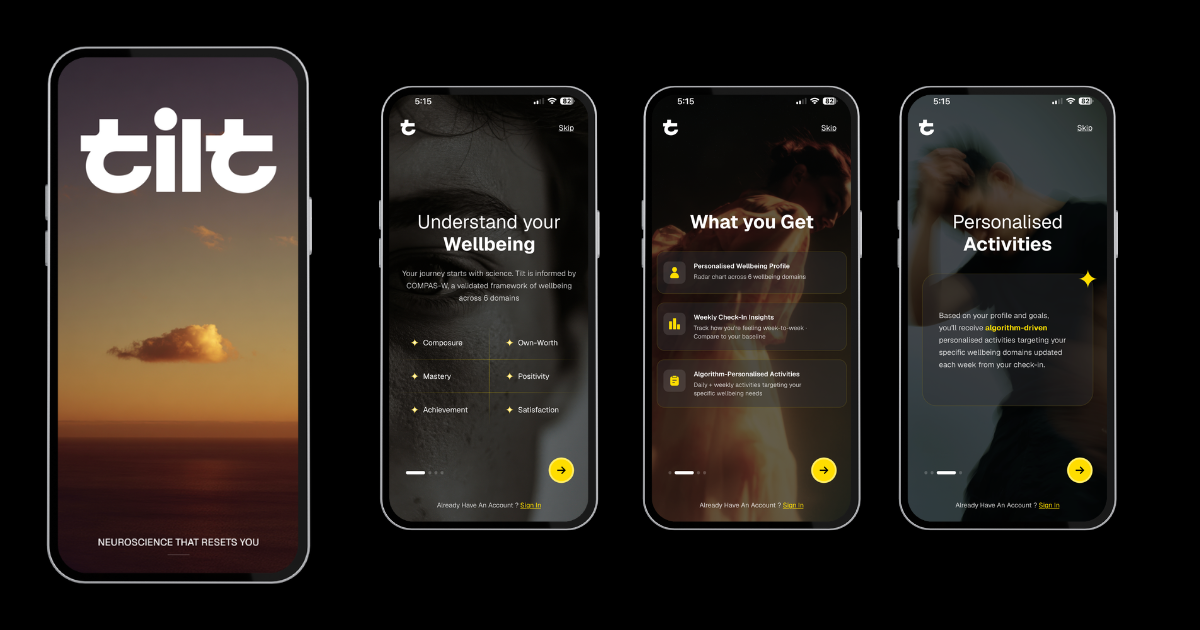 Product & Updates
An introduction to the app and the problem it's solving
Read more From the Founder
The idea behind the name, and what it says about how we think about wellbeing
Read more The Science of Wellbeing
A breakdown of Composure, Own-worth, Mastery, Positivity, Achievement and Satisfaction
Read moreLonger essays and field notes — the thinking behind the science, published regularly on Substack.
 Neuroscience
For most of my career, I sat at the intersection of two worlds that rarely speak to each other properly. In one, we publish papers, test neural networks...
Read more Wellbeing
A little while ago I had a falling-out with someone close to me. The kind that sits in your chest — I felt the situation was genuinely unjust, and the anger sat there for days...
Read more Resilience
Recently, a paper from my team was published in American Psychologist (Connon et al., 2026)—the first findings from a study I began more than 15 years ago.
Read more